Latest Post

Continuing with citations from my article in Obesity Reviews on an aeteological framework for assessing obesity, we now turn to the some of the factors that can affect ingestive behaviour:

Physiological or Homeostatic Factors

In contrast to excess caloric consumption that results largely from environmental determinants, over‐eating in response to increased hunger or reduced satiety can be viewed as a physiological response to a perturbation of the homeostatic system and is perhaps best termed homeostatic hyperphagia. Primary homeostatic hyperphagia can result from genetic defects in the homeostatic system (e.g. leptin deficiency, melanocortin type 4 receptor mutation or Prader Willi Syndrome) and are rare. Secondary homeostatic hyperphagia can result from acquired defects or perturbations in the homeostatic system (e.g. head trauma, craniopharyngeoma, insulinoma). Tertiary homeostatic hyperphagia, by far the most common category, is largely the result of inappropriate feeding intervals and/or nutrient selection. Thus, skipping meals, resulting in a compensatory hyperphagic response (rapid ingestion of energy‐dense foods), is perhaps the most prevalent form of homeostatic hyperphagia. Ingestion of high‐glycemic foods resulting in a rapid rise and fall in blood glucose and insulin levels (‘crash and crave’) may prompt increased snacking and overconsumption, although this notion remains controversial. Meal duration and composition can also affect satiety response, whereby delayed or reduced satiation (e.g. in response to hasty eating, energy‐dense foods, low fibre intake, liquid calories) can result in excess caloric intake. The presence of homeostatic hyperphagia (characterized by over‐eating in response to increased hunger and/or reduced satiety) will likely call for interventions that specifically address the underlying perturbation in this system (e.g. administration of leptin, excision of the insulinoma, correction of meal pattern, nutritional hygiene, portion control, etc.). Patients with obesity resulting from tertiary homeostatic hyperphagia are the most likely to benefit from dietary counselling.

@DrSharma
Edmonton, AB


Michelle shared her Wheat Belly transformation in health and weight, something that none of her doctors helped accomplish. She accomplished all this  on her own–with spectacular results: thinner, no longer a diabetic, reversed fatty liver, rashes, and hormonal distortions.

“Just wanted to share how unhealthy I was pre-Wheat Belly. I did not feel well and had diabetes, high liver enzymes, high cholesterol including high triglycerides, high ferritin levels, rashes and too many other things to mention.

“I started Wheat Belly because my life depended on it. Don’t let your health get that far. I have been on this lifestyle since the end of November, 2017. I still have 34 lbs to go, I could even go 50 lbs lower. But in 6 months, my cholesterol is normal, my A1C went from 9.1 (diabetic) to 5.1. My ferritin level went from a whopping 1538 to normal. (Nope, I don’t have the genetic disorder that causes this.) I was just sooo unhealthy.

“My liver enzymes, ALT and AST, went from the 200’s (non-alcoholic fatty liver which can eventually lead to cirrhosis that is not reversible) to normal. Rashes went away. I can tell that my high estrogen levels (caused by grains and other stuff in food and environment and caused me to have a hysterectomy because of estrogen dominance and because they couldn’t rule out uterine cancer) has gone down. Gosh, I may have been able to dodge that had I gotten on this WOE sooner! Even the hormones they gave me didn’t help. They only gave me severe panic attacks.

“Just think: All I had to do was change my diet. But no doctor told me that.

“All these things went normal in 3 month, but those numbers are where I am at in 6 months. I am 48 lbs down. NOW OFF ALL MEDS and considered non-diabetic.”

Is Wheat Belly about shrinking from XXL to size 4? Yes, it is, but it is SO much more than that, as Michelle’s experience illustrates. It is about reversing type 2 diabetes, fatty liver, skin rashes, hormonal distortions, and many other health conditions, not with prescription drugs, but by correcting the factors that caused these conditions in the first place.

ALL of Michelle’s conditions were easily and readily reversible, yet not one doctor recognized this. Michelle’s experience is not the exception; it’s the rule. I wouldn’t be surprised, in fact, if doctors blamed Michelle herself for her conditions, accusing her of gluttony, excess, immoderation. But the cause was conventional dietary advice coupled with medical ignorance.

The good news: Once you recognize that the doctor is useless, the healthcare system and prescription drugs offer nothing but Band-Aids, but that the answer is in your own hands, then you can be on your way to finding solutions. And look at the magnificent results. This is why I often say that the health that emerges from your own efforts is superior to the “health” the doctor achieves.


The post Michelle’s Wheat Belly health and weight transformation appeared first on Dr. William Davis.


Don’t fall for it—the marketing ploy that wants to convince you that you’re eating a healthy food when you’re not.

Here are six foods that can fool you:

1. Low-Fat Snacks
Studies at Cornell have found that we tend to eat 50 percent more of foods labeled “low fat” than the regular version of the product. Scientists call this “the halo effect,” because eating things we perceive as healthy makes us feel virtuous. Also, many low-fat foods tend to have more sugar to compensate for the lack of fat, which adds flavor. Stick to natural low-fat snacks, such as fruits and veggies, or judicious servings of low-fat dairy such as cheese sticks or yogurt. Or, if you’re opting for low-fat, be very mindful of your portion sizes. Just because a snack is low-fat doesn’t mean you can eat the whole box. Need some help mastering this one? Nutrisystem makes sticking to proper portion sizes simple by doing the measuring for you!

7 Superfoods That Should Always Be in Your Cart

Read More

2. Reduced-Fat Peanut Butter
Not all fat is bad for you. While peanut butter is high in fat calories, it’s chock full of monounsaturated fats, which are good for your heart. And if you read the labels, there’s not a big difference in calories between reduced and full-fat peanut butter. You’re better off looking for reduced or no-sugar (natural) peanut butter which usually has less salt as well as sugar, better for your heart and to lower your risk of type 2 diabetes.

3. Multigrain Bread
Sounds healthy, doesn’t it? But multigrain bread may be no healthier than white bread. Both are made with refined grains—with the fiber removed—it’s just that the multigrain bread includes more than one kind of refined grain than plain old white bread. Check the label of your bread and look for the words “whole grain” or “whole wheat,” or “whole grain flour.” That’s the really healthy bread, chock full of filling fiber. Look for three grams of fiber or more.

How to Build the Best. Salad. Ever.

Read More

4. Fast-Food Salads
Yes, veggies are good for you, but many fast food salads have more calories, fat and sodium than the burgers because of all the add-ons, like cheese, meat and heavy dressings. Like low-fat foods, salads wear that “health halo” that often disguises calorie bombs. Many chains now list calories right in the store; if not, you can find nutritional information on the company’s website. Surf the web before you place your order.

5. Vitamin-Enhanced Water
Again, check that label. One popular brand, while it does contain vitamins, is also loaded with sugar. The difference between vitamin-enhanced water and soda? Just the lack of bubbles. Get your vitamins and minerals from real food.

5 Breakfast Habits That Melt Pounds

Read More

6. Farmed Fish
Fish has some pretty hefty health benefits. Salmon, for example, is one of the richest sources of heart-protective omega-3 fatty acids on the planet. Omega-3s, also found in other fatty fish such as tuna, haddock and herring, help support brain development in the fetus and babies, and fish is an excellent source of protein. Problem is, farm-raised fish is often contaminated with organic chemicals that may raise cancer risk and affect growing children. Experts like the American Heart Association recommend switching to wild caught fish and to eat two servings a week of a variety of fish, including those with lower levels of chemicals such as canned tuna and trout. Of course, some fish is better than no fish, so if farm-raised is your only option, it’s OK to occasionally eat it. Just make sure to opt for wild caught fish when possible.

The post 6 “Healthy” Foods You Should Avoid appeared first on The Leaf.


This is a beginner-friendly circuit workout you can do at home or at the gym. It’s perfect if you’re just getting started in the fitness game or returning to working out after an injury. As always, talk with your doctor before making any fitness changes. Honor your body and modify as needed.

Hey hey from beautiful San Diego! I’m in town for the IDEA conference and so excited to soak up fitness knowledge, take classes, and check out new products from my favorite brands. I’ll be sure to report back with all the details!

In the meantime, how about a workout?
2018 152 ZF 6630 53987 1 102

This one is for my beginner friends, or those who may be getting back in the game following an injury. It’s a circuit workout to work your entire body; all you need is a pair of dumbbells.

Some tips:

– As always, make sure you’re cleared by your doctor to resume, start, or change your exercise routine. Honor your body. If something doesn’t work for you, change it so that it feels good!

– Make sure you execute the movements with proper form. I have lots of form cue tips below, but it’s very helpful to meet with a certified personal trainer in real life to ensure your executing the moves properly and safely.

– Adjust your weights as needed. You may need super light weights or no weights, and that’s ok! If you haven’t been strength training consistently, you’ll definitely feel it! Remember that it’s safer to add on weights than to start ridiculously heavy.

Here’s what the workout looks like:

Total body workout for beginners

Form cues and tips for this beginner circuit workout:

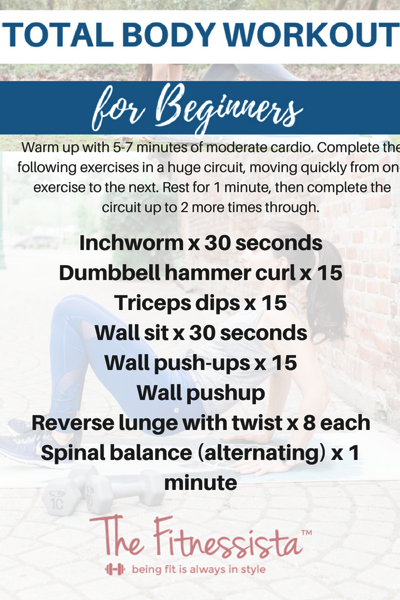
Warm up with 5-7 minutes of moderate cardio. Complete the following exercises in a huge circuit, moving quickly from one exercise to the next. Rest for 1 minute, then complete the circuit up to 2 more times through. Focus on quality of the exercises. It’s better to move slowly and complete two rounds than to rush through it for three rounds.

Inchworm x 30 seconds: Start from standing and bend down in a forward fold, then walk out into plank position – wrists under your shoulders. Walk your hands back towards your feet and come back to standing. For more of a challenge, move as quickly as possible.

Dumbbell hammer curl x 15: Hold a pair of dumbbells by your sides, palms facing in. Bend your elbows as you lift them to your shoulders and return to start. 

Triceps dips x 15: Sit on the floor with your knees bent. Place your hands on the floor behind you and under your shoulders. Lift your butt off the ground (or keep it down for less resistance), then bend your elbows straight back behind you. Make sure you don’t move your hips, just your elbows. Exhale as you straighten your arms. 

Wall sit x 30 seconds: Stand against a wall and slide your back down it until your thighs are parallel to the floor. Make sure your knees don’t extend beyond your toes—you may need to walk your feet out a little—and spread your weight evenly throughout your feet. Hold for 30 seconds.

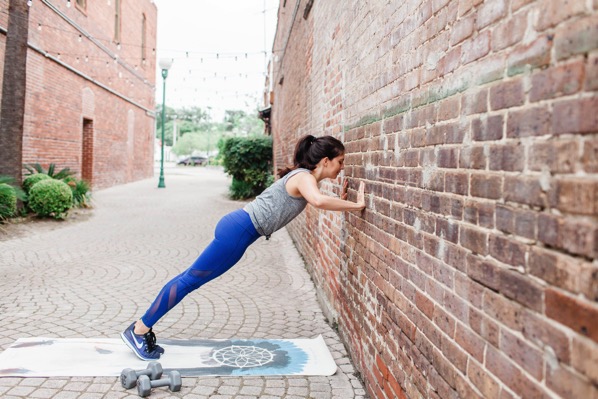
Wall push-ups x 15: Face a wall and place your hands on it at shoulder height, shoulder-width apart. You want to walk your feet out a little further than arms length so you’re at a slight angle. Bend your elbows to lower towards the wall, exhale as your straighten your arms. Keep your core engaged and your body in line.
Wall pushup

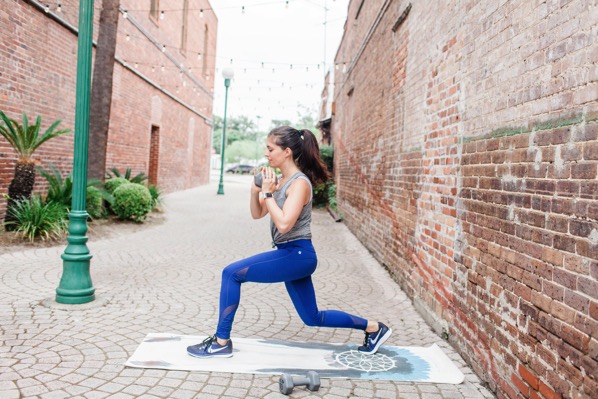
Reverse lunge with twist x 8 each: Hold a dumbbell with both hands at your chest. and stand with your legs hip width apart. Take a big step back to come into a lunge position. Watch your alignment and make sure your front knee is stacked over your front ankle, and your chest is lifted with a tight core. Twist your body towards the front knee, then straighten back out and step the back leg in to start position. Repeat to the other side. 

Spinal balance (alternating) x 1 minute: Come onto hands and knees (hands under your shoulders and knees under your hip bones). Extend one arm and the opposite leg, keeping your hips parallel to the floor.  Squeeze your glute to lift your leg and keep your core engaged. Lower down and repeat on the opposite side. 
Circuit workout for beginners

Please let me know if you give it a try! If you’re just getting into the fitness game, I’m cheering for you!!!

My workout OG friends: when you first got started in the fitness game, what did you do? I started with step aerobics and spin classes, then started to strength train. 

xo

Gina

Photos: Lindsay Colson

Wearing: Lorna Jane tank // Fabletics tights // Nikes 

More total body workouts can be found here.

Psssst. Last chance to order the Blue Apron giveaway!

The post Beginner Circuit Workout appeared first on The Fitnessista.


Another month is over and it has been a corker – we won an award, held our first ever webinar and we’re also well into our Twitter World Cup of MAN v FAT Football team names. Here are the things we learned in June…

A ‘large percentage’ of men in the UK don’t go to the doctor.

Research by Gillette has found that we tend to have an ‘ostrich’ approach to our health, with many of us choosing to just wait it out. But honestly, you guys, if you’re worried about any aspect of your health just go to the bloody doctor. It’s ten minutes out of your day and one of two things will happen: you’ll be told all is fine, in which case: hurrah! Or you’ll start on the path to sorting out whatever is wrong with you, in which case: hurrah! It’s win-win. If you’re not going because you’re imagining the worst, sitting at home isn’t going to cure you though, is it?

93% of us don’t sleep well when it’s hot. 

Can confirm. Professor Cropley, a health psychologist from the University of Surrey, says the way to get over this is to work to keep your room cool – close the curtains during the day, keep your bedroom door open so air can circulate and use cotton bedsheets to increase the chances of getting some quality shuteye in the heat.

Alright so they’re not very photogenic but I can assure you that this was delicious – and 400 cals!

Subway is actually a pretty good shout for grabbing lunch on the go if you’re watching your calories

We’ve been obsessed with Subway this month after our guide to the best healthy options to get while you’re there. Want to keep the calories down? You don’t have to have a salad (unless you want to, of course), and you can still load up on cheese and that sweet, sweet honey oat bread.

Almost half of Brits have attempted a vegan diet, but most struggle to last more than three months

The reason? Lack of support from friends and family. The survey by Kellogg’s found that 88% of people agreed that it’s bloody tough to go vegan, so if one of your mates says he’s going meat-and-dairy-free, give him a high five. And if you’re wondering why Kellogg’s are the ones to be polling the country about veganism, it’s because they’ve just launched a new vegan cereal. Of course.

Things we learned in June

Sorry.

Football fans are boosting the economy by £350 million a day on match days. 

There’s a massive spike in takeaway and beer sales when England are playing, with 59% of people surveyed by shopping app Shopmium saying they see the footie as an excuse to treat themselves to a takeaway. 

Kevin Smith is a Weight Watchers ambassador.

We knew that he’d lost a lot of weight after having a heart attack, but did you know that he’s now a Weight Watchers ambassador? He joins the likes of DJ Khaled and er, Gregg Wallace, to help Weight Watchers target that one sector they’ve always fallen short in: men. Is seeing a famous man more likely to make you go to a WW meeting? We’re not sure, but regardless it’s great to see these guys losing weight and doing well.

What have you been up to in June? If you lost weight, had any non-scale victories or if you’ve learned anything interesting, we want to hear it, so come and join our trumpet-blowing thread over on the forum.


The post Things we learned in June appeared first on MAN v FAT.


MKRdezign

Contact Form

Name

Email *

Message *

Powered by Blogger.
Javascript DisablePlease Enable Javascript To See All Widget